


Facade cornices with KORDEKO flexible board: how to avoid cracks at the joints
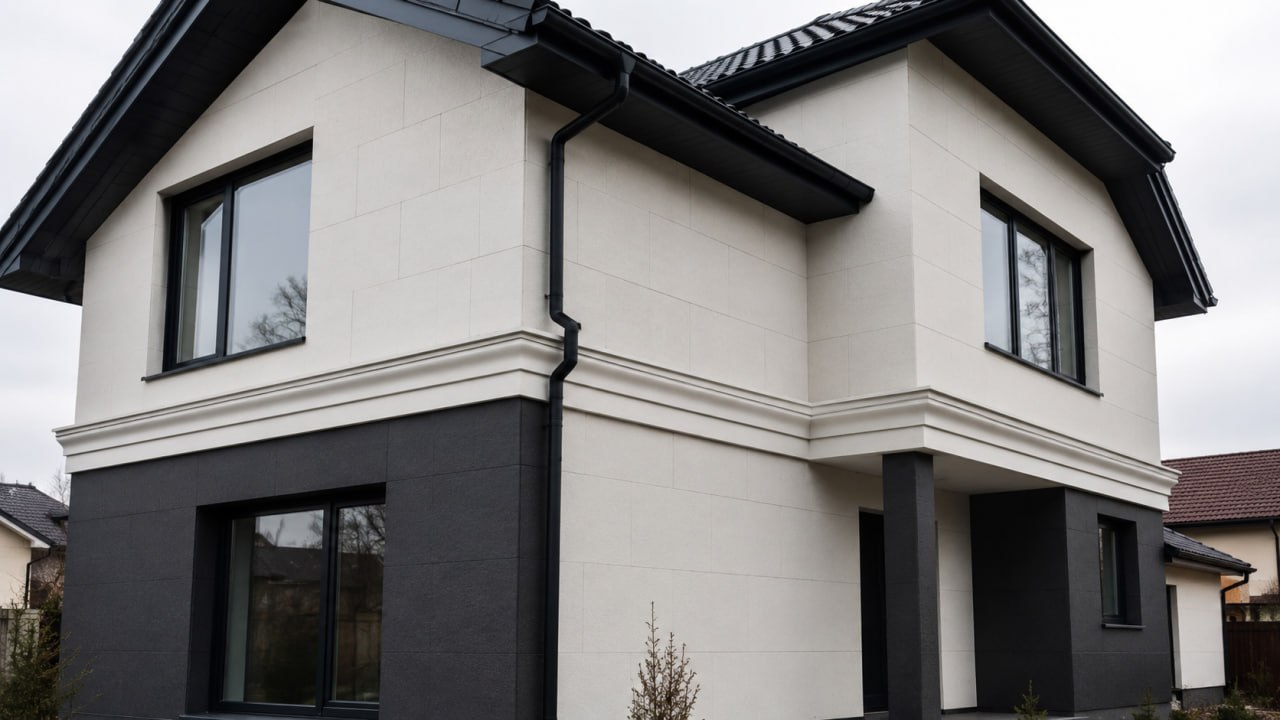
Facade cornices make the house more expressive: they highlight levels, mask passages, add volume and give the facade a finished look. But precisely in the joint areas between cornices, thermal insulation and finishing, cracks often appear, if the technical details are not executed correctly.
The reason is simple: cornice, thermal insulation, reinforcing layer and final cladding must work as a single system. If each element is mounted separately, without a correct connection, over time cracks, open joints and uneven lines can appear on the facade.
Why do the cracks appear precisely in the area of cornices
The cornice is a prominent element. For this reason, it is more in demand than a straight wall:
- is directly exposed to water.
- dirt accumulates on the edges.
- winter is subject to freeze-thaw cycles.
- stresses occur when different materials come into contact.
- Incorrect cuts can create weak areas.
If a cornice is simply "glued" to an already completed facade, without a correct technical detail, the joint becomes a vulnerable point.
The main mistake: the cornice separately, the facade separately
Often, the cornice is treated as a simple decorative element that can be added at the end. In practice, however, it is part of the entire facade system.
A common mistake is the following: first the thermal insulation and the base layer are made, then the cornice is glued separately, and finally they try to adapt the finish around it. The result can be:
- uneven connections.
- cuts too narrow.
- weak joints.
- joints on the upper or lower line.
- risk of cracking after one season.
It is much more correct to determine from the beginning where the cornice will be located, how it will be connected to the thermal insulation, where the reinforcing mesh will pass and how the final finish will reach the decorative element.
Reinforcement — the basis of a stable joint
So that the cornice area does not become a point prone to cracks, the reinforcement must be executed correctly. The mesh must work not only on the straight surface of the wall, but also in the transition areas.
Particular attention should be paid to:
- the upper line of the cornice.
- the bottom line of the cornice.
- outer corners.
- heads.
- of the connections to the eaves and corners of the building.
- areas where the cornice is interrupted.
If the reinforcement layer is executed with interruptions, the crack may appear exactly where the facade should look the cleanest and most uniform.
The cornice and thermal insulation must have a clear connection detail
When insulating facades, cornices should not be treated as a separate decoration. Must be established in advance:
- on which layer the cornice is mounted.
- how the corners are reinforced.
- where the reinforcing mesh passes.
- how the top is protected against water.
- how to connect the final finish to the cornice.
- how ends and joints are closed.
This approach reduces the risk of cracks and helps to make the facade not only attractive, but also durable.
Why is water dangerous for joints?
Even a small water drainage error can damage a well-made cornice. If water stagnates on the top or penetrates the joint, over time there can be leakage marks, dirt and degradation of vulnerable areas.
It is important to provide:
- a fair slope on the upper side.
- a drip pattern or a break in the water flow.
- tight connections.
- lack of horizontal surfaces on which water can stagnate.
- a fair transition to the facade finish.
The cornice must not accumulate water, but contribute to keeping the facade dry.
How to connect the cornice with the flexible board
The final finish must reach the cornice in a clean and precise manner, without rough joints, random bands or visual interruptions.
KORDEKO flexible plate (PletaFlex) is suitable for such details, as it can be conveniently used on facade surfaces, plinths, corners, jambs and near decorative elements. This helps to keep a uniform look and make clean transitions in the cornice area.
Where mistakes are made most often
1. The joint is made without additional reinforcement. If the cornice area is not properly reinforced, the crack may appear right on the joint line.
2. A too narrow strip of board is left. A very narrow piece near the cornice looks visually weak and can deteriorate more quickly.
3. The upper part is not protected against water. If water stagnates on top, it can gradually degrade the joint.
4. The cornice is mounted after the facade is completed. In this case it is more difficult to correctly connect the decor with the thermal insulation system and the final finish.
5. Geometry is not checked. A crooked cornice immediately affects the appearance of the entire facade, especially on long horizontal lines.
Mini-checklist for a correct joint
Before installation, the following must be checked:
- The cornice is included in the overall design of the facade.
- The stand is sturdy and straight.
- Arming is done without interruption.
- The corners and ends are reinforced.
- The upper part is protected against water.
- There is a clean connection with the flex plate.
- The cornice line is straight along its entire length.
- There are no haphazard narrow cuts.
Conclusion
Facade cornices only add value to the house when they are correctly integrated with the thermal insulation and the final finish. The most important conditions are reinforcement, mesh, protection against water and well-thought-out connection details.
If the cornice, thermal insulation and flexible board work as a single system, the facade will have a neat appearance, will be better protected against cracks at the joints and will retain its unitary appearance for many years.
Need advice on your facade?
- ·Get a free consultation for your project
- ·Find out which material suits your facade
- ·We'll answer all your questions and help you choose