


KORDEKO flexible stone: color that lasts on the facade
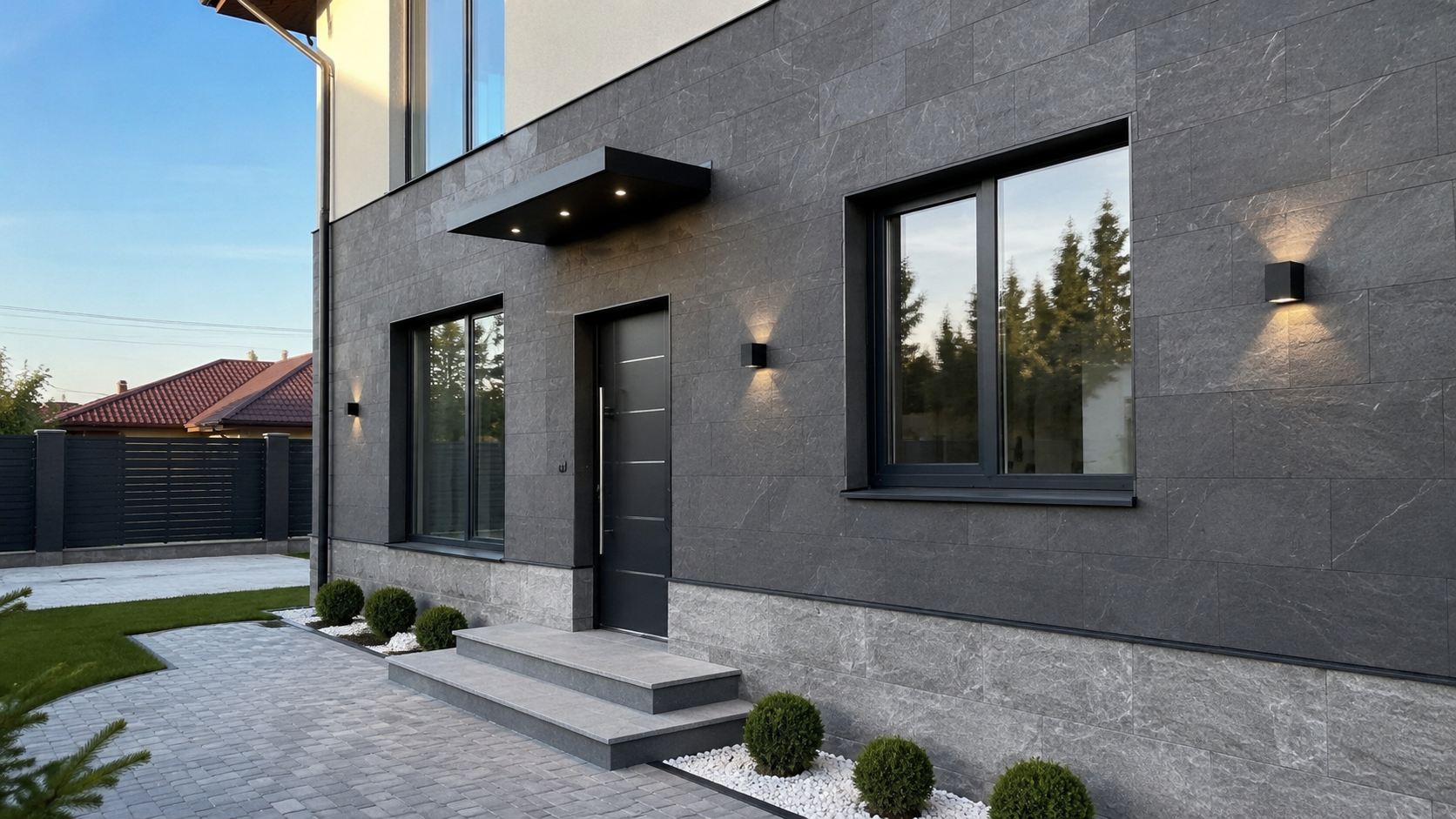
A facade is constantly exposed to sun, rain, wind, frost, and dust. That's why one of the essential questions when choosing a cladding material isn't how it looks on installation day, but how it will look after three, five, or ten years. KORDEKO flexible tile (PletaFlex) is designed for exterior use, and its color is part of the material's mineral composition — not a layer of paint applied to the surface.
Why some facades fade
Fading generally occurs due to the same three factors: weak pigments that succumb to ultraviolet light, thin decorative layers that age quickly, and materials that weren't formulated for continuous sun exposure and seasonal temperature swings. The effect is most visible on the south side of a house, where UV intensity is highest.
At first the color becomes less saturated. Then stains appear, along with visible differences between differently exposed sections of the facade, and finally that tired finish look that points straight to renovation. The problem isn't aesthetic in the abstract — it's a real decline in the property's appearance.
How color is built into KORDEKO
In KORDEKO tiles, the color isn't applied to the surface after production. Oxide pigments — inorganic and chemically stable — are incorporated into the mineral mixture at the manufacturing stage through proprietary PletaFlex technology. As a result, the tint is part of the material's mass, not a surface film that can erode or fade.
The mineral composition — white cement, quartz sand or marble powder, acrylic dispersion, and oxide pigments — is engineered to withstand repeated freeze-thaw cycles, moisture, and UV radiation without changing tone. This isn't a marketing promise: KORDEKO tiles hold Technical Approval No. 001SB-04/1809-2025, issued by Romania's Ministry of Construction through INCD URBAN INCERC, valid until November 2027.
On a real project, this means a facade installed today will look consistent after the first rainy season, and after the tenth — with no retouching, no repainting, no "refreshing" interventions.
Where color stability matters most
There are areas of a building where discoloration becomes immediately visible and drags down the whole appearance:
- Large, open walls with no shading elements
- South- and west-facing facades with maximum UV exposure
- Entrances and portals — high visual-traffic areas
- Plinths and ground-level elements, exposed to splashing and moisture
- Columns, pilasters, and cornices — focal elements that draw the eye
- Surfaces with no eaves or protective canopies
If the material fails in any of these areas, the facade looks uneven: one side lighter, another darker, patches that look worn. Color stability, then, isn't a secondary technical detail — it's the basic condition for a finish to stay a finish, instead of a permanent construction site.
Compatibility with ETICS thermal insulation systems
When facade insulation is carried out through an ETICS system, the final decorative layer becomes the "face" of the entire assembly. If that layer discolors within two to three years, the insulation's thermal performance stays intact, but the homeowner is left with a facade that looks old — and the cost of a new finish applied over a system that was just installed.
KORDEKO tiles are the only natural-stone-look tiles compatible with ETICS systems, thanks to a weight of just 4 kg/m². Natural stone (20–35 kg/m²), ceramic or porcelain tiles (25–35 kg/m²), and paving (53 kg/m²) can't be used over thermal insulation — their load exceeds the system's structural capacity. KORDEKO solves this limitation and additionally adds the thermal equivalent of a 3 cm layer of polystyrene.
See what the results look like in our gallery of completed projects — including facades with a thermal insulation system and KORDEKO cladding.
Zero maintenance for 10 to 30 years
A material that doesn't fade eliminates a whole category of recurring costs: paint, primer, touch-up labor, and periodically erected scaffolding. The appearance lasts 10 to 30 years, without any repainting or impregnation.
Ongoing maintenance comes down to periodically washing the surface with a high-pressure device — water, and that's it. If an individual tile is mechanically damaged, only that tile is replaced, without dismantling the surrounding surface.
For owners of large homes, homeowner associations, or managers of commercial buildings, this means the facade budget after installation stays close to zero for the entire lifespan of the cladding. There's no equivalent among traditional decorative materials — decorative plaster needs repainting every 1–3 years, natural stone needs impregnation every 3–5 years, and ceramics risk frost cracking.
Choosing a color — what to check before deciding
When choosing a facade finish, the sample seen indoors tells only part of the story. Outside, the material behaves differently: light shifts throughout the day, reflections appear after rain, and there's contrast with neighboring elements — the plinth, joinery, roof. A few practical criteria:
- Check that the pigments are inorganic and integrated into the mass — not applied to the surface
- Request independent certification documents, not just manufacturer statements
- Compare the color against available series under natural light
- Account for neighboring tones: if the plinth and cornices will be a different material, choose colors that harmonize
The complete catalog of KORDEKO series and colors — including Rock Stone Mont Blanc, Rock Stone El Arabia, and Butcher White — is available online, with full technical specifications for every product.
Conclusion: a facade you'll never need to repaint
KORDEKO flexible tile (PletaFlex) solves a problem usually considered unavoidable: over time, every facade loses its color. Mineral pigments built into the material's mass, a weight of just 4 kg/m², compatibility with ETICS thermal insulation systems, and a Technical Approval confirming UV resistance combine into a facade that keeps its appearance for 10 to 30 years without a single repaint.
If you're planning facade cladding or facade insulation for your home and want the result to look just as good this year as it will ten years from now — contact us for a free consultation. We'll help you choose the right texture, color, and quantity of material for your project.
Need advice on your facade?
- ·Get a free consultation for your project
- ·Find out which material suits your facade
- ·We'll answer all your questions and help you choose